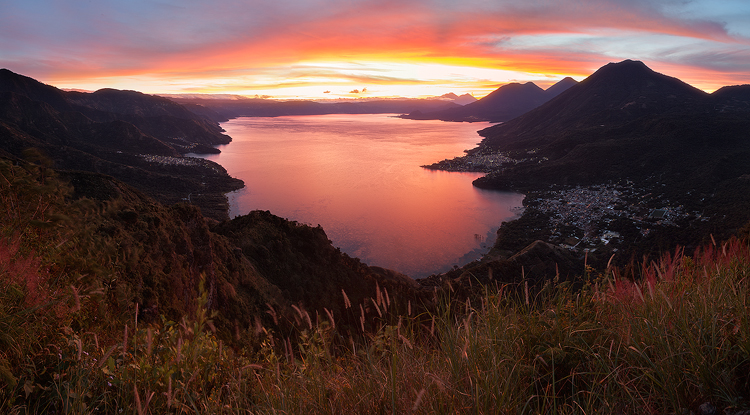
Recently I have been sifting through my archive of RAW files. Looking back through trips undertaken years ago is a somewhat nostalgic experience. Some unprocessed photos taken with my old camera caught my eye. I couldn’t remember why they were passed over the first time, maybe due to technical deficiencies such as poor exposure or flare. Perhaps they were ugly ducklings overlooked in favour of more impressive pictures from the same shoot. I put some through my current post processing workflow and was pleased with the results – you can see examples here and here.

I remembered the first photo I posted to an online forum. It is a sunset photo of a distant Mt Warning in New South Wales, Australia. I now know after examining the filename it was the 191st photo I took with a DSLR. I was pretty chuffed with the results at the time. Looking back I’m embarrassed to say, but willing to admit it looks flat, dark and boring; a far cry from the warm mood and gently rolling hills I was trying to express.

For fun I decided to try improving on the image. Surprisingly I still had the RAW file on my computer. For a more subtle mood I started with a lower overall contrast, and enhanced the tonal separation in the shadows and midtones. This produced more detail and microcontrast. To emphasise three-dimensional depth, contrast was increased at the border of light and shade as the sun washed over the apex of the side-lit hills. The colour temperature was made slightly warmer and enhanced. Finally resizing and sharpening was performed.


In the age of digital photography, the use of creative filters has somewhat diminished as many of the desired effects can now be duplicated in photoshop. However one filter that has not been made redundant by the digital darkroom is the polarizing filter.

A polarizer is often the first filter recommended to a new photographer who is interested in taking up landscape photography. It’s a versatile tool that can add punch to almost any landscape scene, and some professional photographers even leave them permanently attached to their lenses.

There are quite a few articles around describing the effect on an image that polarizers may have, however the best way to make effective use of your photographic tools is to have a grasp on how they work. Hopefully this guide will give some insight into the optics and application of this filter. By the end of this tutorial you’ll understand why this is one of the few photographic filters that cannot be duplicated in photoshop.

Nature of Light

Light is unique in that two theories are needed to explain its behaviour – particles and waves.

The particle theory of light encompasses the notion that a beam of light is made up of little packets of energy travelling through the air called photons. This seemed to explain shadows, as the photons are blocked by an intervening object. Each photon can also transfer energy (or react with the digital sensor).

However certain phenomena cannot be explained by the particle theory: 1) light can also interact with other rays 2) bend around corners and 3) spread out when shone through a small aperture (diffraction). Waves however, do maintain these properties; some other real world examples include ocean waves and sound waves.

With regards to polarizers, we’re more interested in light as a wave and it’s important to understand how this would appear physically.

If we took a straight beam of non-polarized light and viewed it side-on, the wave would look something like below:

This wave can be simulated in reality if you grab a skipping rope and wave it up and down while the other end is held still by someone else.

However keep in mind if this were a ray of light, it’s not a simple sine wave depicted in two dimensions. If we then cut it in half, and looked at it end-on, there would be more waves vibrating in every possible angle.

For simplicity’s sake, I have only shown the oscillation in six meridians, but there would be many more waves distributed in between these. If this were a real beam of light, it would be travelling perpendicular to your computer screen (towards you).

Optics of Polarizers

A polarizing substance only transmits light rays vibrating in one plane, and stops the rest. Think of it physically as a picket fence, or a set of jail bars.

What would happen if you put this in front of our ray of non-polarized light from before?

You can see that the horizontally aligned rays won’t fit through the screen (they’ll hit the sides), but the vertical rays will be able to slip through. Be mindful that in reality, many light rays will be heading towards you, right next to each other (I have only drawn one). Therefore, the resulting polarized light will look something like this:

The light rays will be only vibrating in one plane (vertical) and will be parallel to each other; everything else filtered out. This is polarization. You will still see the object through the filter as the newly polarized light is allowed to pass, however you’ll lose a bit of brightness as you’re getting rid of the rays that can’t slip through the gaps (accounting for the 1 1/3 stop loss that many filters advertise).

Polarizing filters can be rotated, which rotates the orientation of the picket fence, and the idea is to give us control over which orientation of light rays are allowed through to the camera sensor.

Polarizers in Photography

The main uses of polarizing filters in photography are to reduce reflections, and deepen blue skies. Next we’ll look at how these effects are achieved.

Polarizers Cut Down Reflections

When light hits any object three things can happen. It either passes through (transmission), is absorbed (which may gives us different perception of colour, or how bright an object is) or bounces back (reflection). Light will do all three in different ratios depending on the properties of the object. Glass appears clear as it transmits most light, but it still reflects a small proportion. Metals are usually highly reflective, and light bouncing off such a surface may appear as below.

It’s important to note that reflected light is also polarized! If we looked at the ray end-on, after it has reflected it would look like this:

Reflected light is polarized horizontally!

Unwanted reflections interfere with the object behind that we are actually interested in, reducing colour and contrast. It makes sense that if we oriented the picket fence of our polarizer vertically, it will screen out these polarized horizontal rays, and completely suppress the reflections (unlike the previous example where we put the filter in front of unpolarized light – in that case, since vertical rays were getting through, we’d still see the object, just a bit darker.)

In addition to this, if we wanted to let the reflections show up on the photo, we could rotate the polarizer so the slits were horizontal and would therefore have minimal effect.

Image taken with polarizer set for minimal effect (no post processing). Light filtering from the canopy above is reflecting off the leaves of the underbrush, showing up white spots everywhere. This has the effect of reducing the contrast of the leaves, turning them an ugly pale green.

Image taken with polarizer set for maximum effect (no post processing). The reflections have largely been filtered out by the polarizer, allowing the natural colour of the leaves to come through with better colour and contrast.

As an exercise, grab a polarizing filter and put it between your eye and the monitor. Notice how you can turn the filter completely black in a certain orientation – this is because the output from your monitor is polarized!

Polarized driving glasses use this principle to screen out glare from the sun reflecting on the road, and therefore aid vision.

A lot of the time we can’t see through a lake as the light reflected off the surface means it is essentially acting like a mirror and we see the sky instead of the rocks or fish underneath. If we get rid of the intervening reflections, then the water will become transparent, and we can see straight through.

The following two photos demonstrate this effect.

Unpolarized. The water surface is reflecting the sky above, obscuring details underneath.

Polarizer set to max. Reflections have been minimized, and the creek bed underneath can be seen.

Polarizers for the Sky

White light is a mixture of all the visible wavelengths of light: red, orange, yellow, green, blue, indigo, violet (longer to shorter wavelengths).

Light from the sun is not polarized, and contains all of these wavelengths. As the light travels down towards us, it must pass through the earth’s atmosphere which contains particles. Rays of light which hit these particles are scattered (bounced off in a random direction).

Scatter is another method of polarization, and the effect is strongest at 90 degrees to the direction of the sun.

The sky appears blue as the shorter wavelengths of light (blue) are scattered more by the atmosphere (Rayleigh scattering) than longer wavelengths (red). By the time blue light reaches our eye, it is likely to have scattered multiple times, which means that at this time, it is less polarized than other colours.

So if we put a polarizing filter up at 90 degrees to the sun, we are not really screening out the blue wavelengths as it isn’t polarized. However we are removing the accompanying polarized light (which serves to wash out the colour), thus leaving blue by itself so it appears deeper and more saturated.

Unpolarized

Polarizer set to max: 1) Deeper, more saturated sky, 2) Whiter clouds, 3) More saturated water, slightly easier to see through, 4) More contrast/colour in bushes

You may have heard that polarized wide angle lenses have a problem with patchy blue colouration across the sky. Hopefully you can now appreciate why this happens. As previously discussed, the polarization of light is greatest at a 90 degree orientation to the sun, and gradually falls off either side. The wide angle lens catches light from a wider arc of the sun, so there will be a greater difference in the quality of polarized light across the scene, as in the next photo which was shot at 10mm.

Circular or Linear?

Both linear and circular polarizers exist, which gives rise to confusion about which is appropriate to purchase for photography.

Polarized light as discussed in this article is linearly polarized – the waves of light are all parallel to each other.

The significance of this is related to the autofocus of modern camera bodies.

To take a photo, light from the scene enters the lens and camera body. In the body it needs to go to a couple of different places: 1) The eyepiece so we can actually see what we are taking pictures of, 2) The autofocus mechanism.

The camera uses a beam splitter to direct light to different parts of the camera. This works by polarizing the ray into two axes, and sending them in different directions.

If the light entering at step 1 is linearly polarized, we’ve only got one axis to work with (as the oscillation is 2D), and therefore can only be sent one way – to the eyepiece. In practice this means that your camera’s autofocus will not function, as it is not receiving light.

To get around this limitation, circular polarization is achieved by combining a linear polarizer with a quarter phase wave plate. Without going into too much detail, after polarizing the incoming light, the quarter phase plate slows down one axis (eg. horizontal) relative to the other (eg. vertical). Therefore rather than a simple up-and-down oscillating wave in 2D, the output looks more like a corkscrew (see here for an animation). If we took up our skipping rope again, and spun the free end around in a circle, this is how the light wave would appear.

The corkscrew can be split by the beam splitter (as it is vibrating in 3D), so autofocus will work, but still retains the initial polarizing effect.

In other words: Unpolarized light enters camera –> Linearly polarized –> Transformed to circular polarization –> beam splitter

Nowadays circular polarizers are more readily available and have no disadvantage other than cost. Linear polarizers are generally cheaper and will still work, but you’ll have to manually focus the scene.

Conclusion

Polarizers are an essential part of the landscape photographer’s kit. While the sky effect may be duplicated somewhat in photoshop, there is no method of digitally removing reflections and revealing underlying detail (not possible as this information isn’t recorded by the sensor). In the foreseeable future, the polarizing filter is here to stay.

Feb 282012
 

For the first time in weeks I’ve had the chance to process some images. Check out the Brazil and Chile galleries.


Galen Rowell was an inspirational photographer, adventurer and mountain climber who tragically died in a plane crash in 2002. His book ‘Mountain Light’ recounts his life’s adventures and photographic development while providing inspiration and instruction for the aspiring landscape photographer along the way.

Early in the text, Rowell identifies the elements of a great photograph: technical proficiency, fine light and an identifiable personal vision. While photography is a highly technical form of art, technique is quite easily learned and most new photographers with an acceptable grasp of the basics can start making competent photos. On another level, an unforgettable photograph has many less tangible artistic qualities, and it is these aspects Rowell focuses on.

The 224 page book is structured in seven chapters alternating with eight photographic exhibits. The chapters are a pure text collection of Rowell’s photographic philosophies and musings. The early chapters describe Rowell’s childhood; his early love of the outdoors and mountain climbing, and humble beginnings in photography with a box camera all of which set the foundations for his life’s work. Over the course of the book he takes us through significant events that have shaped his personal vision. This enables the reader to reflect on their own photographic processes and make some inroads into the difficult task of translating intuitive vision into deliberate practice. It’s very intriguing, but takes a while to get through as it can be heavy going at some points.

Far from being self-indulgent with over-analysis and rambling prose, Rowell takes the reader on a journey infused with his spirit of adventure and passion for the outdoors. As he describes his image making processes there are many practical tips about effective composition and light. Despite placing less significance on equipment, he also acknowledges that it is important to many photographers, and one chapter which follows him on assignment for National Geographic is dedicated to this.

Interspersed with the chapters are a series of photo exhibits. In a nod to the importance of fine light, Rowell has arranged the exhibits by the quality of light they were taken in, such as magic hour, back light, soft light and night. Each exhibit contains several of his famous photos with an accompanying essay which describes the history of the subject, and gives insight into his inspiration, vision and the image making process. Many photographers only shoot landscapes at sunrise or sunset – and while this light is certainly spectacular, rigidly placing limits can only also limit creativity. Rowell demonstrates how to take advantage of any lighting situation by understanding its strengths and limitations.

The first edition was published in 1986 so a lot of the technical details are film-specific, and you won’t find any tips on post processing in photoshop.

In summary, I highly recommend this book to anyone with an interest in outdoor photography who is keen to develop their personal vision beyond gear and technique. It goes beyond the basics of exposure and the rule-of-thirds to explore some of the subtleties of vision and light. In addition to being a collection of amazing photographs, the lessons learned are timeless and one can take more from every read-through.

Click here to search for the best price on booko

Have a landscape photography book to recommend? Post a comment below.

Dec 102011
 

I’ve started to upload photos from my recent trip to Everest Base Camp into the new Nepal gallery. As always, I have hundreds of RAW files to get through, so more photos will be added on a regular basis. Check it out!

Dec 032011
 

For years, camera enthusiasts have been searching for an acceptable carrying system whilst out on the trail. Photographers have a couple of specific needs: to haul a bulky and heavy array of camera gear in addition to backpacking essentials, and have quick and available access to the camera body. So far, many products on offer have fallen a little short, however I’m quite pleased to present my solution that worked well on the two week trek up to Everest Base Camp.

What I’ve tried so far

Firstly I’d just like to revise what I’ve tried so far, and why it hasn’t worked out.

The Crumpler Whickey and Cox (now Crumpler Karachi Outpost Medium Size) and Lowepro Pro Trekker 300 AW are  that don’t scream ‘expensive stuff to steal inside!’. However the entire interior contains divisions for camera bodies, lenses and accessories only with no room for a warm jacket or bottle of water, making them hugely impractical for walking anywhere more than a few hours. Luckily Nicole has been on hand to help out with these essential needs!

The Domke F2 is a great bag for shooting out of while around town! For ease of access to the camera, quick draw and stowaway and the ability to change lenses, working out of a shoulder bag is unbeatable. The F2 holds a tonne of gear for its size and it looks stealthy. No wonder it’s the choice of many photojournalists around the world.

Domke make an attachment which attempts to convert the F2 into a pseudo-backpack. I thought this sounded like a great solution for an overseas trip that would involve mainly wandering around cities, markets and festivals, where the bag could be converted for the occasional day-hike. Problem is, for me the FA-100 just doesn’t work well. There’s no padding, so the straps cut into your shoulders. In addition, the weight of the bag doesn’t sit too well on the hips, meaning you’re carrying it all on the shoulders which is not ideal. In addition, there’s no convenient way to attach a tripod. I tried it out once on a short bushwalk in Australia but this was enough to make me retire the FA-100 asap.

I was a bit unprepared for the Inca trail, the only daypack I had on hand was a regular backpack, so I stuffed the Domke insert from the F2 into it and got on with it! I also carried my tripod on its own slung over my shoulder. Needless to say this didn’t work well at all. I ended up carrying the camera for most of the walk in my hands under the protection of my poncho due to the teeming rain, as the backpack was not nearly waterproof enough. In addition, the small daypack wasn’t designed to carry heavy camera equipment, and I ended up ripping off one of the shoulder straps completely. Don’t even get me started how silly and uncomfortable it was to carry a tripod over one shoulder for 4 days!

I tried hiking around Patagonia with the Lowepro Toploader clipped onto the backpack shoulder straps. This gives great access to the camera which is right in front, while all other gear and lenses go into the backpack.

The disadvantage I found with this method is that the chest bag tends to drag the whole backpack forwards and downwards. Usually when you fit a backpack you want the weight to be distributed to the hips, however the chest bag pulls the whole thing onto your shoulders making it extremely uncomfortable. I also tried wearing it separate from the backpack using the chest harness that Lowepro offers. While this didn’t pull the pack down, I felt that it still put too much weight on the shoulders. In addition I found the bag obscures your view immediately in front, making it tricky to walk down steep trails or stairs.

My solution?

These are the bags I used on a 14 day hike to Everest  Base Camp. On this trip we were supported by porters, and only had to carry items needed during the day.

The Loka backpack is close to the perfect photographer’s daypack. It’s similar to a regular hiking backpack, but F-stop offer a series of different sized camera modules (ICU) to slot inside. For more information, read this review. To pair with it, I wanted the smallest waist pack which would hold a camera body with zoom lens attached and chose the Kinesis holster.

I found this combination worked really well. Here’s why:

  • Access to the camera is right in front of you, which makes shooting easy and fast. When you have to set the backpack down, and unpack the camera every time to take a shot, usually it’s a case of ‘can’t be bothered’, or you irritate your hiking buddies and end up not taking photos at all.
  • The weight of the camera is around the hips. In addition, the ICU of the Loka is located at the bottom of the backpack, which is where the heavy items should be.
  • The waist bag doesn’t obscure your field of view as much as a chest bag, which makes it easier see directly in front to walk down slopes.
  • The Loka has a lot of straps and attachments. You can put a tripod on the back, and trekking poles on the sides if you desire.
  • Dedicated partition in the backpack for other lenses and accessories, while still having room for gloves, clothes etc. You can customise the amount of space to dedicate to camera gear by putting in a smaller or larger ICU.
  • The Loka has a pouch which fits a Camelbak water bladder – very handy!
  • F-stop make a raincover which can be stashed underneath the pack. This was very useful!
  • The kinesis system is also modular. If you want to add a lens case, or filter pouch to the waist belt – you can!

There are still a few ways I feel  the Loka could be improved:

  • The shoulder height of the harness is not adjustable. I’m fortunate in that the Loka fits me reasonably well, but it would be uncomfortable for those with longer or shorter torsos.
  • The walls of the ICU aren’t really stiff enough. I found they tend to collapse and deform under the weight of items on top.

Obviously the perfect solution for hiking with a DSLR needs to be tailored to the type of hike you are undertaking, and the goals for your photography. If you need to carry more gear, then F-stop make slightly larger backpacks – the Tilopa and Sartori. Alternatively you could consider throwing an ICU into a regular 70L backpack. If you’re going to be doing any sort of climbing or scrambling, then you probably don’t want a bag hanging off the front. However for most non-technical hiking, where comfort and ease of access to the camera are important – consider the backpack and waistpack combination.

How do you carry your DSLR while trekking? Post a comment below.

Nov 302011
 

I’ve just returned from a two week trek to Everest Base Camp. We were fortunate to even start the hike, as the flights from Kathmandu to Lukla were grounded due to heavy fog for 6 days. Although overall not an uncommon event, it is quite unusual to happen so long after the monsoon season has finished. We managed to scrape through on one of the few helicopters, as they flew lower to the ground where visibility was better.

I have an even larger backlog of RAW files now – look out for a Nepal gallery soon!

Published!

 Posted by  Publications
Jun 292011
 

I’m excited to say that an article I wrote about the polarizing filter will be featured in the July issue of Australian Photography Magazine.

Australian Photography is the country’s oldest photography magazine, having been in publication for 60 years. It contains a great mix of photography tips, reviews and inspiration so grab a copy if you have the chance!

Update: Article is available from here


I’ve always wanted a 10 stop ND, however the other options were never that viable. Hitech make a slide in 10 stop ND, however users reported a strong magenta cast, as well as patchy exposure due to light leakage between the filter and holder. B+W make a screw-in 10 stop which looked good, but would also be a pain to setup and use with grad NDs.

The filter is made out of glass, and comes in a 4×4″ case. Other than the filter itself, you receive a laminated exposure card, and a leaflet from Lee that explains how to use it. They talk about setting up, exposure, white balance (admit to a colour cast but don’t specify what it is) and noise due to long exposures. They also talk about a couple of problems unique to film including reciprocity failure and the possible need for colour correction filters (although again they don’t really say exactly which ones you need).

Issues for the Lee Big Stopper to address would be a) light leakage and b) colour cast.

To start with, the filter comes with a foam gasket on one side. This is designed to bridge the gap between filter and holder when placed in the first filter slot, forming a light seal. I have a Lee holder.


The foam feels reasonably durable, but I can’t really comment on how it will stand up over time, it feels ok.

There looks like a small gap in this photo, however the filter was probably pushed down a little far.

The foam gasket does not quite reach all around at the vertical and horizontal points of the holder. The rest of the seal is made with the adapter ring, which sits a tiny bit further back than the holder (less than 1mm). There isn’t a perfect seal with the adapter ring, but the gap is so tiny, and there is a fair length of foam I can’t see this being a problem.

Initial reports have disclosed a cool colour cast, which was the case with my example. AWB should sort most of it out, with the rest correctable in PP. The next two shots were taken with WB set at tungsten. The first had no filter, while the second had the big stopper.

There’s a bit of optical vignetting in the second photo, as the shots were taken at f/2.8 and 17mm. For field use you probably need to cover up the eyepiece for a complete light seal, which I didn’t do here.

The glass reportedly contains an infrared filter..the absence of which is the cause of the magenta cast in strong resin NDs such as the hitech, or when stacking weaker ones together.

Cokin Z-pro holder
: I’ve never actually held one, but going on pictures I don’t think this filter will be compatible. The slot closest to the lens appears to contain some plastic stubs designed to hold a polarizer, which would interfere with the foam seal. Again I’m not 100% sure about this; whether they can be removed or the holder can be reassembled a different way.

© 2010 - 2012 Thomas Young Suffusion theme by Sayontan Sinha